Cane Work in Glass: Millefiori, Reticello and the Patterns Inside
The patterns in a piece of worked glass start as a rod, long before the piece takes shape.
See the Heady Gallery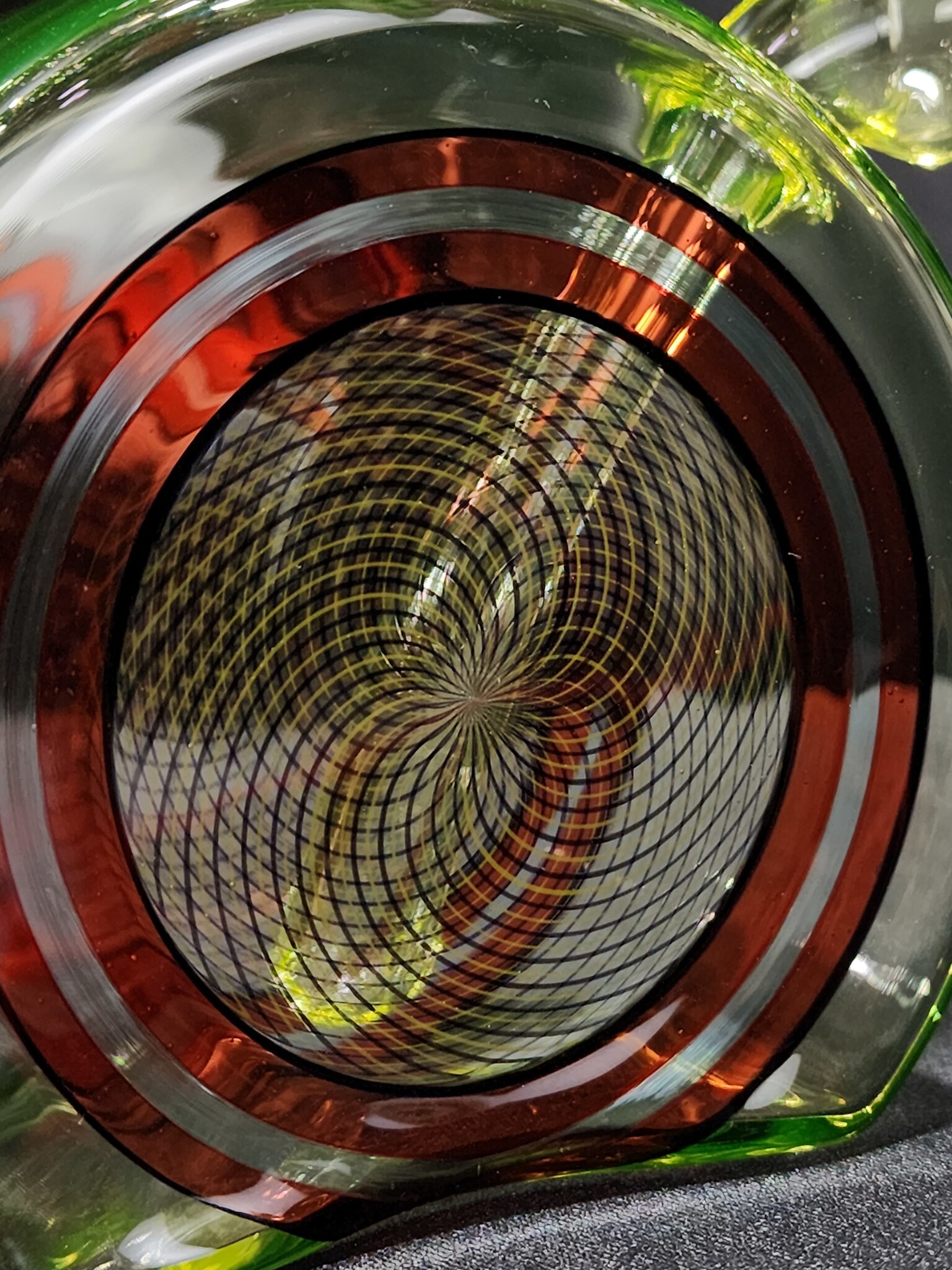
Look closely at a worked piece of glass and you'll often find a pattern that runs through the glass itself: tiny flowers, a fine net, a spiral of lines. None of it is painted on.
Those patterns are built from cane, rods of glass made first and worked into the piece later. The techniques behind them are centuries old, and most of their names come from the glass furnaces of Murano, near Venice.
It starts with cane
Cane is simply a rod of glass used as raw material. Some cane is a single colour. Patterned cane is built up in layers or bundles while hot, then pulled: stretched long and thin while it is still soft.
Pulling is what makes fine detail possible. A pattern that is several centimetres across in the hot bundle keeps its shape as the rod gets longer and thinner, so it ends up small enough to fit dozens into a single piece.
Millefiori and murrine
When a pattern runs the full length of a cane, cutting it into thin slices reveals the same design on every face. Those slices are called murrine.
Millefiori is Italian for "a thousand flowers", after the flower-like patterns these slices so often carry. The technique is ancient: mosaic glass of this kind was made in the Roman world. The word itself is much younger. The English glassmaker Apsley Pellatt used it in his book Curiosities of Glass Making, and it entered the Oxford English Dictionary in 1849. Before that, such beads were just called mosaic beads.
The craft faded by the 1700s and was revived in the 1800s, when makers in Italy, France and England began producing millefiori again. Glass paperweights packed with millefiori became one of its best-known uses, and Murano became the place most associated with it.
Filigrana and reticello
Filigrana is a family of techniques developed on Murano in the 1500s. Canes with threads of opaque white or coloured glass are laid side by side, picked up on a hot gather of clear glass and blown into shape.
- Mezza filigrana: parallel threads spiral around the piece from top to bottom.
- Reticello: two layers of threads twisted in opposite directions are joined, so they cross and form a fine net of diamonds. A tiny air bubble is often trapped in the centre of each diamond, and a good reticello piece has them evenly spaced.
- Zanfirico: canes whose threads are themselves twisted into a spiral or lattice. The name comes from Antonio Sanquirico, a 19th-century art dealer, though the technique is far older.

The same ideas at the torch
Murano's furnace workers made these patterns in soft soda-lime glass. Today's flameworkers use many of the same ideas at a bench torch, usually in borosilicate glass.
- Artists pull their own cane in the flame, twisting colour lines into spirals or stacking them into repeating linework.
- Reti sections, the flameworker's shorthand for reticello, are built from two twisted layers of line-worked tubing.
- Incalmo (often spelled encalmo) joins two separately formed sections while hot to make one clean band of colour.
- Small millefiori slices, called millies, are set into a piece and encased in clear glass.
For more on borosilicate, fuming and annealing, read our guide to borosilicate, colour and craft.
What to look for up close
- Even spacing. Lines in a spiral or net should keep a steady rhythm all the way around.
- Clean crossings. In reticello, look for regular diamonds and evenly placed bubbles.
- Crisp murrine. The design in a slice should be sharp, not smeared or stretched out of shape.
- Smooth encasing. Clear glass over a pattern should be free of cloudiness and trapped debris you weren't meant to see.
- Consistent colour. Bands and lines should hold their colour where sections are joined.
Worth knowing: Small irregularities are part of hand-pulled cane, and no two pieces come out the same. Even spacing across a whole piece is the real test of skill, because every line was placed by hand.
From the shelf
Cane work in the Heady Gallery


Most pieces in the Heady Gallery are one of a kind and name their maker.
General information about materials and craft. The Smoke Hut sells to adults of legal age in their province.